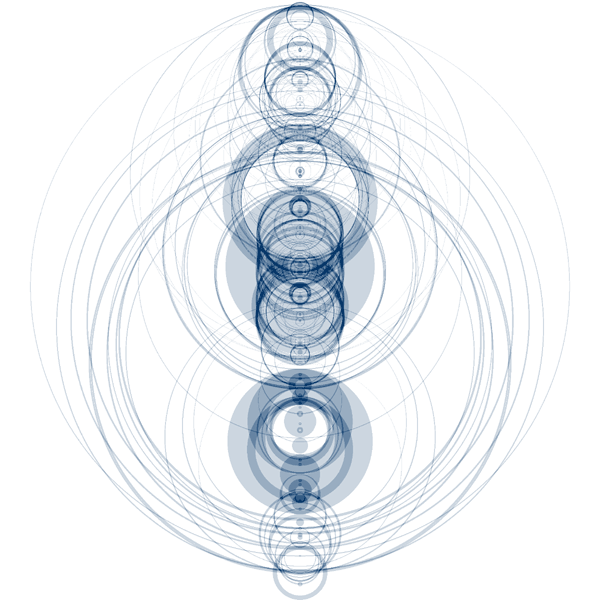
Digital artist Martin Watternberg tackles a highly challenging question in his project entitled The Shape of Song. The visualisation above is for Beethoven's popular Moonlight Sonata. And perhaps the strangest thing about the question "What does music look like?" is the apparent disinterest we collectively have in answering it. Before the advent of computing, the field of music visualisation was limited primarily to a very small group of individuals in long arduous pursuits spanning several centuries.
Although Watternberg's approach to answering the question "What does music look like?" is radically different than those who undertook such explorations in the past. There is an array of comical and sometimes tragic stories relating to individuals who attempted to visualise the content of music in realtime through the use of mechanical devices attached to organs. These are generall known as colour organs. In them, each note of the scale was assigned a colour. They usually took up a great deal of space and many burnt down.
How can we make the best and most relevant of humanity's existing understanding available to all in a form worthy of the 21st century?
German Idealist philosopher Friedrich von Schelling once noted that architecture is solidfied music ("Architektur ist erstarrte Musik") and Arthur Schopenhauer came to the same conclusion pronouncing architecture to be "frozen music".
If the statement "Architecture is frozen music" is indeed true, then it must follow that music can be seen as fluid, dynamic architecture. If we adopt this notion then questions arise as to which elements of architectural vocabulary will best express harmonic characteristics of music and which will can dictate rhythm. To my knowledge, this line of enquiry has rarely been pursued although it promises to yield much fruit.
The logical option for creating a unified approach to this synesthesic response to music is to assign discrete colours to a certain pitch as has been common for centuries. Many composers had very precise notion of what colours are conjured up in the mind of the listener by certain tones and combination thereof. This mapping of colours is the most common form of synesthesia associated with the medium of music. But music is of course far more than mere tonal expressions. A melody only results from the organisation of tones in time (generally depicted horizontally), while harmony results from the interaction of overlapping combinations of different tones (depicted vertically).
Returning to the architectural metaphor, tone might be understood to the bricks and mortar of musical composition, leanding a work its texture and colour. However, it is the arrangement of the bricks in space that makes them architecture and it is also the arrangement of tones in time that lend them their musical quality (rather than just being random notes). To put it more clearly what I am actually driving at:
The rhythmic arrangement of music can be expressed geometrically.
The intellectual implications of this understanding of music are quite daunting considering the aforementioned vacuum of discourse in relation to this thinking. Physics terms our reality 'timespace' which indicates the interwoven nature of space and time. One cannot exist without another. But what is the term for time being transposed into space or space into time? What would the Taj Mahal sound like? What sort of building would Mozart's Requiem Mass be? These are engaging questions worth musing, but my focus is slightly different.
My interest is in the possibilities arising out of the digital realm for reinterpreting music and the way we understand it. It is my conviction that music *seen* rather than explained might be a more edifying approach to music theory. To cast a wider net, an earnest partnership between the visual and aural must be undertaken without prejudices and the avarice of an art protecting its delicate milieu. Rather, a certain abandon must be adopted for 'unstaking' the terriotory of the mind with a view towards later repopulation with more integrated understanding of different arts. The interdependance of the senses must be expressed in the arts themselves. I assert that the adoption of any such approach must ultimately start with music, which represents the roots of art itself.
Of course, this notion really represents a return to the archaic in the sense that early human cave rituals encapsulated flickering visual wall art and dance with sounds and songs of humans in naturally domed enclosures. This was the birthplace of art - as a whole. In that sense, the idea of time manifested in space put into practise might look like a return to ancient practices. And it becomes increasingly apparent why architecture and music are so inextricably linked, from La Scala to Çatalhöyük.

Keine Kommentare:
Kommentar veröffentlichen