Freitag, 10. Oktober 2008
Archaic Music and Temporal Proximity
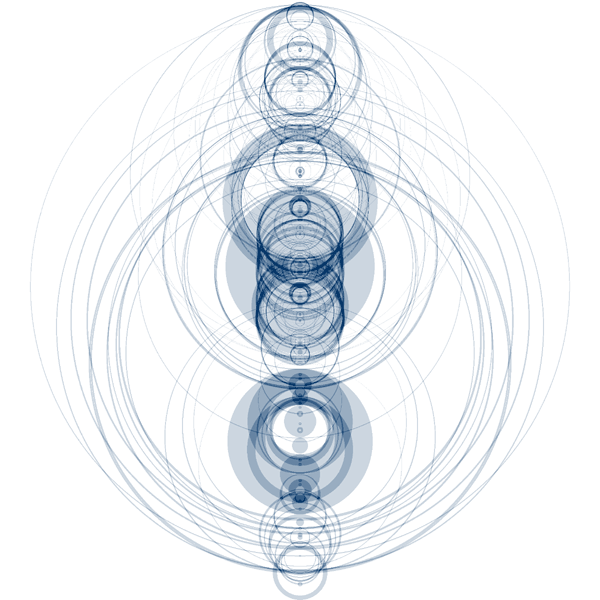
Many years ago I concluded that the modern emergence of bass-laden, beat-dominated music was significant beyond the realm of arts. Ties to archaic musical culture and its ability to inform the present hinted that such music is informing our understanding and perception of time. Perhaps it is reviving a lost understanding of time; a revival of archaic perceptions of time.
It became clear to me that all such compositions both archaic and modern were built with specific interaction between the tactile, audible, and visual represented in the humanities as dance, music and visual arts. The music was palpably constructed in a way to promote certain physiological movements of those dancing based on the basic parametres of the human body in which relations between body parts generally adhere to natural matemathical laws - as does tonality.
Architecture is also optimised to enhance an optimal range of sound with minimal disturbance. But more importantly, people naturally trace patterns around the various axes of their body when they dance. As they do this, they are mimicking the elements of the rhythm in the air as they dance, tracing a pattern through space to manifest the elapsing of time in the a meanful way with the physical body. So when, for example, we use long exposure on cameras to capture the trails of movements, we see the 'fourth dimension' manifested in the three dimensions of space.
I am now looking to gather the yarn up and thread an understandable package to leave behind the thicket of confusion, in order to discern the patterns of a highly ordered architecture revealed in auditory composition. Indeed, perhaps mysterious relations in one's personal temporal structures are capable of being consolidated into instantly perceivable order which is also managable.
One obvious means of visualising this pattern in space is as a basin of temporal density to which certain events are either more or less proximate. At the centre of the cone there is a denser area of events (in music beats or tones) that are most temporally proximate to the subject. The temporal proximity of encounters or actions in real life could also be given a rough value and in this way be assigned a position in three-dimensional space. The regularly with which each occurs would determine their 'loop' length. If we look at life in it's most basic components, it is the meaningful interaction of various rhythms and patterns that determines personal fulfilment, happiness and sense of purpose. From the seemingly mundane diurnal patterns of daily life to the the monumental, protracted events of our time. Each seeks to find a link to each other. To find relevance and resemblance across scales. To interact to form complex tempro-architectural strutures - towering stuctures with interlocking levels of relation.
At a more compressed temporal level. The syncopation of beats affords satisfying variation to our experience of the moment as such. Beats scatter and disperse monotony from the moment, injecting surprising glitches, amusing stupefaction and a 'different groove' to set our personal clocks to.
..............................
Because the constraint of thee-dimensional space, distance, is temporarily subverted by the Internet being almost instantaneous around the globe, the importance of our notation of time and the roles of our current calendars play will need to be reconsidered and perhaps intergrated into temporal schedules* that are better suited to digital possibilities, specifically, that are able to weigh temporal relevance in a instantly understandable way. Helping us to priorise and sort events based on their temporal proximity.
* Schedule is derived from the Latin word schedula meaning 'strip of paper', in turn derived from the Greek skhida meaning 'splinter'. Its use as a printed timetable is relatively recent. I propose the use of time stripes organised into a meaningful strucutre to supersede the need for timetables.
The goal of any form of notation must be to alleviate the person of overly cumbersome thought processes in an efficient way so one can better direct intellectual resources to achieving a goal rather than merely sorting through a puzzle of possibilities.
Mittwoch, 1. Oktober 2008
Temporal Proximity Schedule
Relative temporal proximity is a more important factor than contiguity in an absolute sense.
The critical factor to understanding and effectively interacting with others in many situations is not temporal contiguity within an unfolding event, but rather its relative temporal proximity to others. This is not at a supericial level, but rather also the interplay between different levels of temporal proximities, which is to say that there are various levels of temporal 'distances' running parallel. Like a sort of conical circumference these help frame our point of reference. Pictured visually these might be depicted as concentric circles emanating out from one's temporal point of reference or origin. This relatively simple model is complicated by the dynamic nature of what can ultimately only be experienced. Indeed, David Tinapple asserts it is only through a changing point of reference that perception occurs as such. In the same way we only attain depth of visual perception through the assimilation of biocular vision, so too our temporal perception represents a continual search for reference to temporal events in the environment. We define objects getting a sense of their proportions (viewing them from different sides), and we find it easiest to recognise objects movements against their surroundings. Infact, we primarily recognise the style of mvement of others rather than their shape. We map out the schedule for our lives congenerously against the backdrop of the temporal landscape.
Attempts at sensory deprivation show that it is nigh impossible to prevent subjects from retriving temporal indicators from their envirnonment - usually by the primative and matural of sense of sound. The sounds help the person plot their temporal course in their landscape and ultimately seems to keep them sane. I would assert, that the most basic need of animals beyond air, water and sustainance is in fact the ability to calibrate largely unconscious internal rhthyms with externally derived sensory inputs. It may sound obvious to pronounce this, but it is only under such extreme circumstance of sensory deprivation that the importance of such rhythms becopmes apparent. In everyday life these are naturally calibrated.
Calendars such as the one shown above seek to attune the long-term cycles of large groups of people to the needs and demands of the culture as a whole and coordinate tasks, establishing them as rituals. They are by nature cyclical and serve to peg our understanding of the world to a codified constant. Representing one of the most important artifacts of any culture, the calendar is the key to understanding a society.
What does our calendar say about us?
Samstag, 27. September 2008
Notational bias and the limits of musical notation
The conventions we necessarily employ to navigate our path in the world, to simplify repetitive tasks, tend to become so ingrained in us that we sometimes consider them to be natural laws and thus universal. Monolingual English speakers scan text from left to right and from top to bottom and find often think this natural. It is hardly surprising therefore that any 'up' is usually considered more and better. Any notation represents a cultural convention, but to what extent does the notation we use influence thought and cause cultural bias? Goerge Boole asserted in Laws of Thought that 'language is [..] not merely a medium for the expression of thought'. And the Sapir–Whorf hypothesis articulated the intuitively felt influence that a language has on the habitual thoght of a speaker. So how do the conventions influence us at a personal level apart from helping to define our cultural operating system? I have long felt that conventional Western musical notation is not only limited as a form of musical representation but has unwittingly skewed our understanding of music itself.
The coding system of music is nonlinguistic and involves a unique combination of attributes. It requires 'a strict and continuous time constraint on an output that is generated by a continuous stream of coded instructions' (http://en.wikipedia.org/wiki/Eye_movement_in_music_reading).
Further, I am of the opinion that musical notation necessarily struggles to tackle modern muscial forms. This need not be seen as a problem for contempory musicians who would probably never consider notating their music in conventionl forms. Indeed, hiphop or electronic musicians might rarely notate music at all. Of course this raises the question, what does this music look like and what form of notation might be suitable for its visual representation. Of course, it is quite possible that musicians would resist any abstraction of the aural experience they craft into the visual realm. But it is my view that we live in a culture which historically has been dominated by the visual sense and that it is only naturally to seek visual corroboration of input derived from other sense. Generally, to see is to believe and we *see* what others mean. In fact the words 'see' and 'know' are connates in many languages. The etymology of 'vision' reflects this, for example.
To a certain extent, the task of music visualisation is one VJs are landed with at nightclubs, but they can always cast their work as an accompaniment or parallel artform and are not held to any standard. The visual stream they generate need not represent any essense of the audio offered. And indeed many seem to take pride in divorcing their output from the music itself.
The evolution of music videos through the advent of MTV also offers a source of countless interesting visual renderings of music. Much the same as with the output of VJs, however, music videos seem only loosely associated to the
The coding system of music is nonlinguistic and involves a unique combination of attributes. It requires 'a strict and continuous time constraint on an output that is generated by a continuous stream of coded instructions' (http://en.wikipedia.org/wiki/Eye_movement_in_music_reading).
Further, I am of the opinion that musical notation necessarily struggles to tackle modern muscial forms. This need not be seen as a problem for contempory musicians who would probably never consider notating their music in conventionl forms. Indeed, hiphop or electronic musicians might rarely notate music at all. Of course this raises the question, what does this music look like and what form of notation might be suitable for its visual representation. Of course, it is quite possible that musicians would resist any abstraction of the aural experience they craft into the visual realm. But it is my view that we live in a culture which historically has been dominated by the visual sense and that it is only naturally to seek visual corroboration of input derived from other sense. Generally, to see is to believe and we *see* what others mean. In fact the words 'see' and 'know' are connates in many languages. The etymology of 'vision' reflects this, for example.
To a certain extent, the task of music visualisation is one VJs are landed with at nightclubs, but they can always cast their work as an accompaniment or parallel artform and are not held to any standard. The visual stream they generate need not represent any essense of the audio offered. And indeed many seem to take pride in divorcing their output from the music itself.
The evolution of music videos through the advent of MTV also offers a source of countless interesting visual renderings of music. Much the same as with the output of VJs, however, music videos seem only loosely associated to the
Donnerstag, 4. September 2008
The Shape of Song
Digital artist Martin Watternberg tackles a highly challenging question in his project entitled The Shape of Song. The visualisation above is for Beethoven's popular Moonlight Sonata. And perhaps the strangest thing about the question "What does music look like?" is the apparent disinterest we collectively have in answering it. Before the advent of computing, the field of music visualisation was limited primarily to a very small group of individuals in long arduous pursuits spanning several centuries.
Although Watternberg's approach to answering the question "What does music look like?" is radically different than those who undertook such explorations in the past. There is an array of comical and sometimes tragic stories relating to individuals who attempted to visualise the content of music in realtime through the use of mechanical devices attached to organs. These are generall known as colour organs. In them, each note of the scale was assigned a colour. They usually took up a great deal of space and many burnt down.
How can we make the best and most relevant of humanity's existing understanding available to all in a form worthy of the 21st century?
German Idealist philosopher Friedrich von Schelling once noted that architecture is solidfied music ("Architektur ist erstarrte Musik") and Arthur Schopenhauer came to the same conclusion pronouncing architecture to be "frozen music".
If the statement "Architecture is frozen music" is indeed true, then it must follow that music can be seen as fluid, dynamic architecture. If we adopt this notion then questions arise as to which elements of architectural vocabulary will best express harmonic characteristics of music and which will can dictate rhythm. To my knowledge, this line of enquiry has rarely been pursued although it promises to yield much fruit.
The logical option for creating a unified approach to this synesthesic response to music is to assign discrete colours to a certain pitch as has been common for centuries. Many composers had very precise notion of what colours are conjured up in the mind of the listener by certain tones and combination thereof. This mapping of colours is the most common form of synesthesia associated with the medium of music. But music is of course far more than mere tonal expressions. A melody only results from the organisation of tones in time (generally depicted horizontally), while harmony results from the interaction of overlapping combinations of different tones (depicted vertically).
Returning to the architectural metaphor, tone might be understood to the bricks and mortar of musical composition, leanding a work its texture and colour. However, it is the arrangement of the bricks in space that makes them architecture and it is also the arrangement of tones in time that lend them their musical quality (rather than just being random notes). To put it more clearly what I am actually driving at:
The rhythmic arrangement of music can be expressed geometrically.
The intellectual implications of this understanding of music are quite daunting considering the aforementioned vacuum of discourse in relation to this thinking. Physics terms our reality 'timespace' which indicates the interwoven nature of space and time. One cannot exist without another. But what is the term for time being transposed into space or space into time? What would the Taj Mahal sound like? What sort of building would Mozart's Requiem Mass be? These are engaging questions worth musing, but my focus is slightly different.
My interest is in the possibilities arising out of the digital realm for reinterpreting music and the way we understand it. It is my conviction that music *seen* rather than explained might be a more edifying approach to music theory. To cast a wider net, an earnest partnership between the visual and aural must be undertaken without prejudices and the avarice of an art protecting its delicate milieu. Rather, a certain abandon must be adopted for 'unstaking' the terriotory of the mind with a view towards later repopulation with more integrated understanding of different arts. The interdependance of the senses must be expressed in the arts themselves. I assert that the adoption of any such approach must ultimately start with music, which represents the roots of art itself.
Of course, this notion really represents a return to the archaic in the sense that early human cave rituals encapsulated flickering visual wall art and dance with sounds and songs of humans in naturally domed enclosures. This was the birthplace of art - as a whole. In that sense, the idea of time manifested in space put into practise might look like a return to ancient practices. And it becomes increasingly apparent why architecture and music are so inextricably linked, from La Scala to Çatalhöyük.
Montag, 25. August 2008
Memory Tower at the Closing Ceremony of the 2008 Olympics

Welcome to the Conical Time blog. I assume as posts accumulate the purpose of this blog will become increasingly apparent. Here goes.
Yesterday, August 24th 2008, saw the close of the 2008 Olympics Games in Beijing, the XXIX Olympiad. The Closing Ceremony in the Beijing National Stadium ('Bird's Nest') starting at 8:08 pm. In Chinese culture numerology is popular and the number eight is associated with prosperity and confidence. The Arabic numeral for eight indicates its significance in others cultures too. Some commentators protested against the continual focus on the number eight (the Olympics also started on 08.08.2008 at 20:08 local time) as they felt it to be too 'masculine'.
As expected, the closing ceremony was a grandious and involved event with the usual trappings including dignitaries and celebrities. One acrobatic item on the agenda was something called the "Memory Tower" by the event's organisers. A YouTube video of the performance can be seen here.
The event is described as follows in Wikipedia:
Performers on a tall pillar (called the memory tower), waving arms and symbolising the Olympic flame, eternally unextinguished. Performers group to form Chrysanthemums, with hurdle runners on top of the pillar. Performers then reclimb the pillar, which is then covered in huge red streamers. Roses are formed along with athletes below (with pillar as a stigma), the athlete crowds as petals. Red streamers are levitated upward and reveal the performers arranged in the form of Dancing Beijing, the 2008 Olympic logo.For a culture preoccupied by symbols and form and clearly very mindful of the visual effects created by performances, I found the "Memory Tower" to be quite a potent symbol of memory visualised. Over 300 acrobats were harnessed in concentric circles leading up to the top of the 'pillar', or what I would describe as a cone shape. They were dressed in outfits which were red on one side and sliver on the other and moved rhythmically to the accompanying music. A number of performers raced from the bottom to the top of the tower before posing in what seemed to represent athletes in moments captured from the games. Clearly this performance was intended to be reflective and was more musically subdued than the other performances.
It was proposed to me many years ago that memory in the brain works something akin to a cone, where we funnel our way in to certain memory areas of the brain and that it is in this way that we built 'bridges' from one memory to another (e.g. with mnemonics). It seems the Chinese involved in organising the ceremony have similar ideas. Such an elaborate performance was obviously not done without ample consideration. So now for the tricky question:
What is the shape of memory?
Abonnieren
Kommentare (Atom)